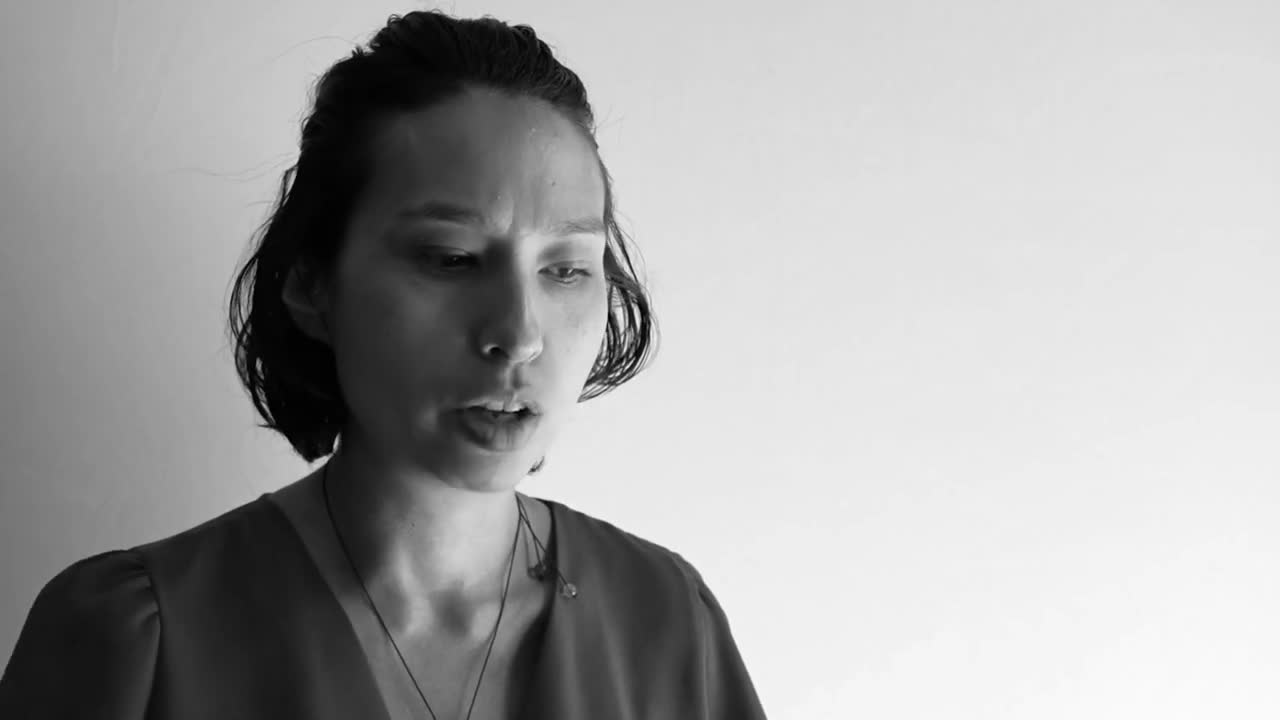
Sylvie Barbier
The Metamorphose Opera
Spoken in English. Their words, as they said them.
For me, one of the portal into presencing and transformation is through art, and I found that for me, it's has been one of the most effective one for myself, both as a path into receiving it, but also transmitting. And I had always had a fascination for the origin of great Greek theater, which is to connect to the divine, and to create a space for catharsis.
And so the idea of Metamorphose is to re honor and to repressence that intention of the great theater, and so I call it a transformative opera. Opera in the sense that it compose multimedia, it compose has dance, it has singing, it has visual art. Scenography has all the dimensions of arts into one moment. To touch all the senses and englobe the audience into a transformational interactive experience.
And so Metamorphose is really what the name says, is the journey of Metamorphose that we all go through individually, and for humanity as a collective. Because to be alive is to have movement. To be alive is for change. And is moments of transformation that are full of mystery but also are dangerous. You know, for the butterfly to come out of the cocoon takes something and we don't know exactly what happens in this cocoon.
And so the piece start with basically cosmic birth, and so I arrive with a white bedsheet representing a ghost because the figure of the ghost is universal across cultures. And why is that figure so universal? Because it speaks to a deep truth, which is if you haven't completed your past, it comes haunt you. If you haven't completed with your blood ancestors and your spiritual ancestors, it comes haunt you. And so on that sheet is also projected image of the fires that are going on in the world, because that is the karma that we're inheriting. That is the karma that we're living now. And how do you have your ghost and ancestor be at peace? Well, you must honor them. You must honor them and see what you wanna let go. You must forgive and be forgiven.
So the first piece is that cosmic birth. This first chapter and picture is the cosmic birth. And it's an interactive part where I use the power of sharing the stories of my ancestors for the audience to also share the stories of their ancestors, so it becomes real. It becomes present. It's not an abstract thing. It's happening right here between you and I. And after that chapter, when I let down of the white bedsheet, I come into a form that is a very animalistic form on quite four legged, very animalistic position and posture. And the four legged is is very intentional, because if there's one thing that is very singular to humanity is our verticality. And our verticality is an embodiment and an embodied representation of our consciousness, because when you're horizontal, you're asleep. You're literally unconscious. And when you're vertical, this is when you awaken. And so, at first that creature is four legged, and gradually it discovers It has awareness, consciousness of what is this hand, what is those hair and the the awe and discovery of the body. And gradually for this discovery, the verticality appears. But with the verticality comes a pulling from the ground. You go from horizontal one with the ground to being pulled from the ground. You with the gain of that consciousness and awareness comes also the very first trauma of being separated from earth, being separated from mother, because the first trauma that we experience is birthing, is no longer being one with our mother.
It's the scream of being separated from mother earth, so the gain of consciousness comes at a cost also. And then the journey continues is which is well, once you're born and conscious and in discovery, you're born in a cultural context of your family, of your country, of the world, and the condition.
And you are given gifts or their intention were to be gifts, so I'm then being dressed by, my collaborators who are extraordinary musician, Mathieu Lebrun and Leticia Donoma. And so they give me a long wig and two crutches and a dress, and I start dancing in very dislocated form, very powerful dislocated form. Because in our life, we receive things that were given as gifts maybe, but they're what we internalize as social construct, social expectation. And I chose for my path to blonde wig because I thought that I should be blonde, you know, the standard of beauty was the Barbie image. And the crutches represent what you think you should become, you know. I don't know. You should be a lawyer. You should be a graphic designer. You should and so you inherit those and you try to navigate through the world with those and you think you're walking, you think you're powerful, but actually you're going with crutches.
And so there's a moment of letting go of those crutches that you've internalized and inherited, and discovering what it is to be able to move and dance in the world liberated from those expectation that we then internalize in ourself. And that comes to maybe an as a for another liberation.
And so then the movement become very fluid, it's an embrace, and in the embrace then comes the desire to meet the other is falling in love. And, I then dance with this kind of like pillow pillow puppet men because it represents falling in love, but do you fall in love with the person, or you fall in love with the projection of an ideal? You fall in love with what you think is love, and that falling in love may become from wanting to compensate. So do you make love to really who is in front of you, or do you make love to your trauma, to your hurt? And often in relationship, at some point comes a moment of I love, I hate you. I I I can't be without you, but I can't be with you either.
You're actually probably meeting your hurt, your first hurt of separation. And so there's in this intense turmoil of wanting to fuse with the other, wanting to be one with the other, to no longer be alone, there's also all that rage and then comes separation. I can't be with you. Finally I got I get to be alone. The freedom of being alone. I get to do what I want when I want. Finally.
And so then in that moment I sit in a chair and I was like, oh, finally alone and free. Free from others.
But in that chair, they're full of chains and you chain yourself into your solitude. You're free and yet you're alone and you're utterly alone and you have to confront how lonely you are, how afraid you are of your loneliness.
And comes a scream of despair, of the fear of being alone and wanting to call for help but no one comes.
But the scream transforms into a chant, and the chant is the reconnection that the loneliness is only an illusion. Then you're not alone.
And so that's another liberation, the liberation of the illusion of being alone. And so you touch a bliss, a bliss of oneness, of truth, and comes a dance, a free, beautiful free dance. And on that dance, there's a desire to share, to share and connect with others, to share the light, to share the path. And so then I stand on that chair to wanting to share the path, and so the movement are wanting to open and give, but gradually the movement become more and more rigid, and it becomes no longer a sharing but a dictating of the path. It's this way. So from something that came from touching a great light comes a great shadow of the dogmatism, which is actually a fear. The source is a fear. The control comes from a fear. So I have to tell you what to do. Go there. Go there. And the more people don't do what I wanna do, the more I wanna control or even if they do what I wanna do, I wanna control even more. And so I still stand on that chair full of chain. And then from that moment comes the only thing that can stand in front of a controlling dogma dictator, you cannot just let it happen because otherwise it keeps spreading. But if you yourself become combative, you become the dictator too. So it's the figure of the solid mountain of love that comes to put a stop, so where all the fear can dissipate and represencing can be present.
And that's when someone can be that for you, can be loving you unconditionally, but stand for you. You meet your tribe. The desire again to meet your family, to feel a sense of belonging, but not just belonging to a lover, but belonging to a clan. And that's a fundamental human need to feel that you can belong to a tribe. So it's another connection to be part of a collective. But when you're part of a tribe, so that's a very tribalistic with a lot of drum dance. But when you then become a tribe, you belong I belong to this tribe and not to this tribe. So then again comes separation and opposition, and comes war, us against them. So the first chapter is the individual transformation, the individual metamorphosis, And the second part is the collective transformation. But they're needed. You have to go through needing to find your tribe to go and transcend integrate and transcend the limitation of the tribe. And ultimately then the figure of the artist becomes the figure of the oracle that sings two prophecies that happens. So when you then are completely in touch with yourself, you no longer speak you become a vessel, something that communicates. That's the figure of the oracle and the chorus They are there to tell to the audience, the public, the prophecy, the truth that they need to hear so that they're awakened to themselves. And so there's the song of two prophecy that are wrapped. A prophecy of a dark age that is to come and a prophecy of a second renaissance that is to come, and they both coexist in the same moment. They come together.
And it's a prophecy and a calling for us to nourish the hope, the seeds of a second Renaissance, where human being get to repressence themselves to something bigger than themselves, a renewal in religion, in mystical wisdom, tradition, combined with what modernity has given us and yet transcending our past. And only then only then after all of that past can something truly new arise. Otherwise, we will still be haunted and trapped with our ghosts.
So that's Metamorphose.