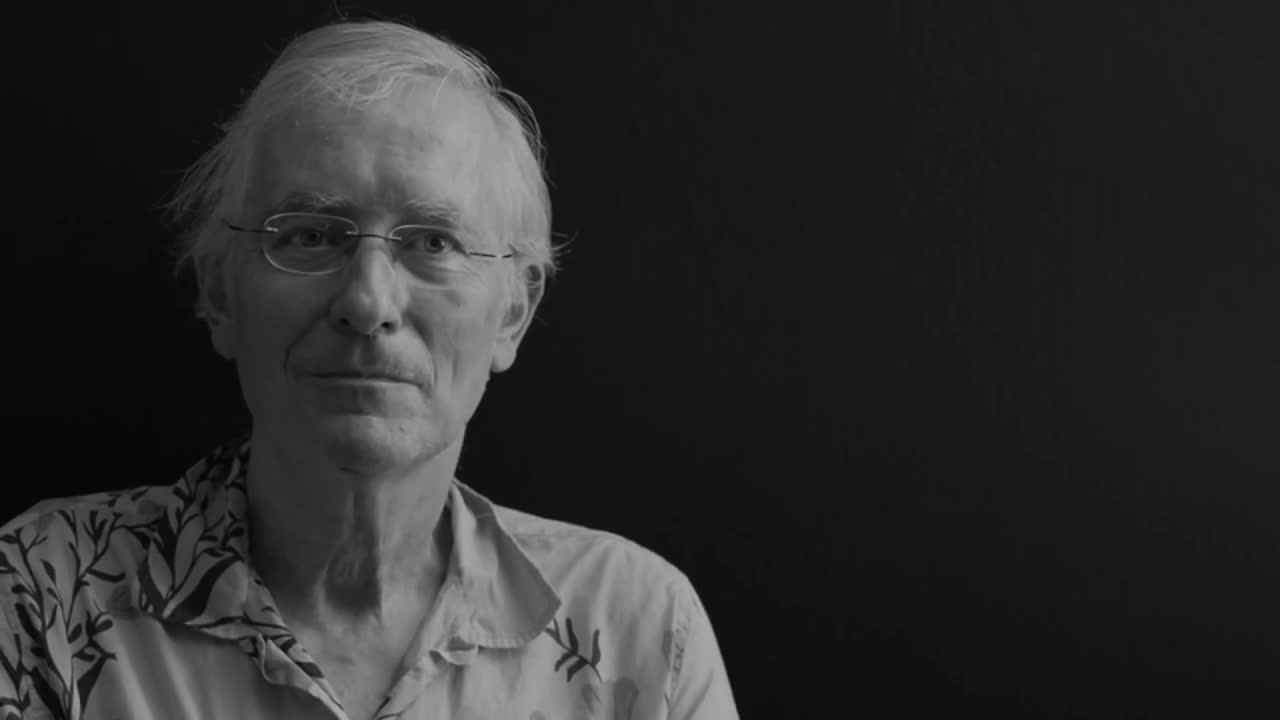
Thomas Steininger
Trans-individuation and the common field
Spoken in English. Their words, as they said them.
Something different happens when mutual understanding is possible. That's the creation of culture. And there is a beauty to create mutual understanding. There is a beauty in not just putting my what I have to say to you right now on you but try to be in an awareness where, yeah, this is me and there are things I would love to share that are dear to me and, yeah, my life work.
The work that I am involved in since many decades is oriented, it's very much to do this in communion Big word, I know, but I like it also in its bigness. Communion. It's not just encounter, but communion which in itself is a very spiritual connotation.
Just the very fact that this presence, this present moment, is a shared one.
And it's a shared one in its wholeness.
What I usually do lives in dialogical fields.
Emergent interbeing work, as we call it. Also, emergent dialogue, there are different variations of the same. It is an awareness of this interbeing that we are in. It's also worth mentioning that the term interbeing is also a term that is very much coined by Thich Nhat Hanh. And we are sitting here in Bejorak next to his Plum Village. So, I'm a very Although I have a different roots to this word interbeing, but I very, honor Thich Nhat Hanh's coining of this term in his way. I have a different twist on it. That's why we also call it emergent interbeing. So, we are more focusing on this emergent capacity when something, comes out of it in its aliveness. Not that Thich Nhat does not do it, but our emphasis is very much. But it is something that speaks to me, speaks to me. And that's why I like this term. There is a wholeness of what we are in, embedded in. Embedded in, at the same time we constitute it. It goes both ways. And it's a wholeness that has its own life form. And, at least to my understanding, not many people pay really deep attention to to this dimension.
Our philosophy or philosophical thinking about it is also that the ISA culture, and I am just talking about Western culture, so deeply immersed and embedded in the at least five to ten thousand years of individuation process, which is a powerful process and an important process. But it has its shadow side because to the capacity that I'm capable of saying me, I need to make the distinction to not me. And the narcissistic outcome of our postponement culture where people are to a huge degree incapable to not self reference everything. Everything is everything is about my self reference in that. Has its genocide.
Because there is a wholeness that I only can become aware when I'm, to some degree, at least a little bit, free of myself?
My concerns can be part of it, but can I have such a light touch with them that they are not coming in the way of it? It's not that I need to be free of my self concerns, but can I be free of my self concerns in that way that I am not completely enslaved by it, so that I am aware of the wholeness of presence?
To the degree that I can do that, and to the degree that you can do that and everyone else present can do that, there is something possible that is only then possible, which is mutual understanding.
There is something opening that we call in our work synergetic intuition.
And I find this a very interesting word, synergetic intuition. It sounds a little lofty at first sight. But it means nothing else than first, do we allow our differences to be part of the presence? Don't we just, put some monotonic, oneness on on that, where we have agreed on something, but where we, I don't understand. I have troubles with all. Can we allow this all to be present?
And, particular in that where differences becomes difficult to not lose each other.
What I mean is, us stay interested in each other. Don't fracture. Because in the moment of fracturing, that's the moment where this greater friction of 'I don't understand it' changes the conflict. Where basically I want to put my context on you for example, or you want to put your context on me. But to the degree that we don't do that because we honour the shared context, I still maybe have troubles with that. But there is a human maturity in myself and yourself to hold this discomfort and to stay in the interest. And there is no guarantee for that, but the likelihood is that out of this can come a creative understanding that I on my own would have not been able to and you on your own would not have been able to, we needed each other also in the friction to allow this third perspective to arise. That's where it becomes synergetic. That's where it's becomes a generative insight.
And that allows a very different way of being together.
But in order to do that, I I have to develop a different relationship to my individuality, which does not mean to give up my individuality.
In fact, the way I would describe it, it needs even more of my individuality, but in a different way. Because the the power of individuality is the power of choice. That I know. I want to agree. No. Yes. I agree. No. I disagree. This power that I'm not just part of a collective, maybe a tribal collective or a traditional collective, but I have the individual responsibility to response to reality as I experience it. That's I think also the power of Western culture because Western culture has developed this to an enormous degree. It is, to my understanding, also one of the foundations of our democracy, that we choose and vote in that.
But in order to come together, it's not just, no, I want a different it's I have to response to a wholeness where my individuality is needed to respond not just for my needs and my self concern, but to a wholeness that I am aware of. That can be now a big democratic context or a big cosmic spiritual context or that can be just the context of our situation here right now that I respond to how I am aware of the wholeness being with you, your project, me sharing this, and how I feel.
This can be mutually beneficial in that. And something can emerge out of that. But it needs my capacity, my individual capacity to respond to something bigger than myself. That's why we sometimes call this capacity also trans individuation.
That's more again the philosophical thinking behind it. That there is something that you could call pre individuation when people in tribal contexts or traditional contexts have the gravity field more in the collective than in the individual choices. And the individuation process that has its height in our postponing culture where me and myself are concerned is basically one of the most sacred values that we have. And maybe the necessity to go beyond that in a transcend and include way, go beyond that, that something can flourish between us.
I see it as part of the human growth process to develop this awareness.
In many dimensions at the same time, there is inner work where when I'm not aware of all my ambitions, fears, all that is part of us also, and I'm not at least to some degree aware of it, the likelihood that it will interfere and dominate is very high. And it's There are only very few people, if at all, who can claim to be really, deeply free of that. But we can cultivate a certain freedom which I am, in my understanding, is not nothing but a freedom for availability, such that I am available for the situation with you without imposing inappropriate stuff into that.
It also has dimensions that our conversation is not in a vacuum. There is a world situation. There is a civilizational crisis. There is a climate disaster we are in. And I don't even know how to hold this in, but not to hold it out either. This kind of culture, society related and birth related dimensions. There are dimensions that are deeply religious, spiritual. What I mean in that it makes a difference if in our meeting there is something like a shared reverence to what we call the good. Or if one of us just doesn't care about it. That's the point that it changes it changes the situation between us if there is not that we necessarily reach it but there's a longing to reach for the good, for the good, the true, and the beautiful, to put, all three up here.
And to find our old ways to do that allows a different way of coming together in this.
So there are all these dimensions we could talk about at length that need individual and collective care for this interbeing to show up. But one of the qualities that I cherish so much in that is what I call a different way of coming together as humans in a small scale.
And there is a lot I could say about that but I would like to illustrate it with a simple example. And it just happened a month ago. In fact, in this very setting, in this very house where Elizabeth and I held an ten day intensive training for our emergent interbeing work with experienced practitioners of this.
And what I experienced there that really encouraged me was something, and forgive me even to use another lofty word, an autopoietic collective wisdom process. And what I mean, or at least how I experienced it and how I interpret it, are when the people present in in a certain setting, and this was a setting that we developed over ten days, are so attentive to this shared field that we are in. And, at least to a degree, free of their personal interference in that.
The meaning field, Oh, what is this about what we are doing right now? What does it mean for us? The word meaning not mainly in the cognitive sense of meaning, although I don't exclude that, but more in the existential sense of meaning.
What's happening between us means something to me. And I don't even know I would not be able to have a rational I mean this this I just existentially awareness this is meaningful to me. And when there is a shared meaning in a dialogical situation showing up, two people, three people, 10 people, a 100 people, this field doesn't just hang around, which is meaningful. Meaning has a certain quality, at least I would say so, that it is looking for more of itself.
Meaning, it's always looking for more of itself. So, when I we don't really interfere, we allow this meaning field also to find its own dynamic of looking for itself. There's all the diversity, it is present, the different backgrounds.
And in that, the meaning field becomes self generative. It's not I am doing something with that or someone else is doing something. Meaning is looking for itself through us. It somehow even turns it around. Meaning is looking for itself through us, not we are are trying to find it. So the subject object relationship turns around if I may say so. And the field between us even would go so far becomes somehow the teacher.
What wants to emerge between us as being meaningful and where this wants to go tells us what to do in order to follow it. But it needs a lot of maturity of the present people to allow this to happen.
And I see this as a cultural achievement because then all the diversity of who we are, we don't necessarily have to work it out. We just can contribute with that. And the richness of our diversity can synergize instead of getting into culture clash with each other. And I see a huge human potential in that capacity in individual relationships, in small group settings, but also in the cultural fragmentation that we experience right now in the culture wars that our civilization crisis is in right now. So that's where I feel that could be also a contribution to create an antidote to fracturing by being able to sense the possibility of synergy and hold the complexity in that in an open society.
And just as one illustration point, it's a very simple one, but I'm still struck by it. The end of these ten days, we we had, as you do, prepared the last day, the last hour, took the right ritual, the right settings so that everything can come to a closure.
So we were coming to the end of this week and as you usually do, you prepare how to find the proper endings or the right closure. And you prepare things like that. But when, the time came, it was very apparent that we did not need to do that. But the shared space was very aware of the fact that this is the last day, that this is the last hour, and it was very aware what the right things were to respond to this. So it sounds a little crazy, but that's how I experienced it and also how others experienced it. Our shared interbeing space responded to the quality of the time in an autonomous, generative way that allowed the ending to find itself. They waited, Okay, that was the end point and it was very clear that it was the end point. But it was not we creating that or we designing it. It was our shared a field responding to the quality of the very moment.