Lenses
A lens is how you say what you want to see in a room — in your own words — and have every moment held up against it.
An axis
An axis is two things you write:
- The claim
- A sentence or two saying what a high score has to do, and what a low one looks like. You are describing a judgement, not picking a category.
- The two ends
- A short phrase for each end of the scale.
Once written, every moment in the room is read against it and placed, with a line saying why it landed there. That line stays attached to the score.
The three that come with every room
Adopt one with a click; it becomes your room's own and you can edit its words.
- reach
- a lived incident, told → a principle, stated
- subject
- spoken of others → spoken of self
- certainty
- settled conviction → worked out live
Compose a lens
A lens is two axes crossed, with every moment in the room placed on that ground.
- In the studio, click + Compose one under Lenses.
- Choose what runs across and what runs up. Pick an axis the room already has, adopt a template, or write your own.
- The ground fills in as you commit each direction.
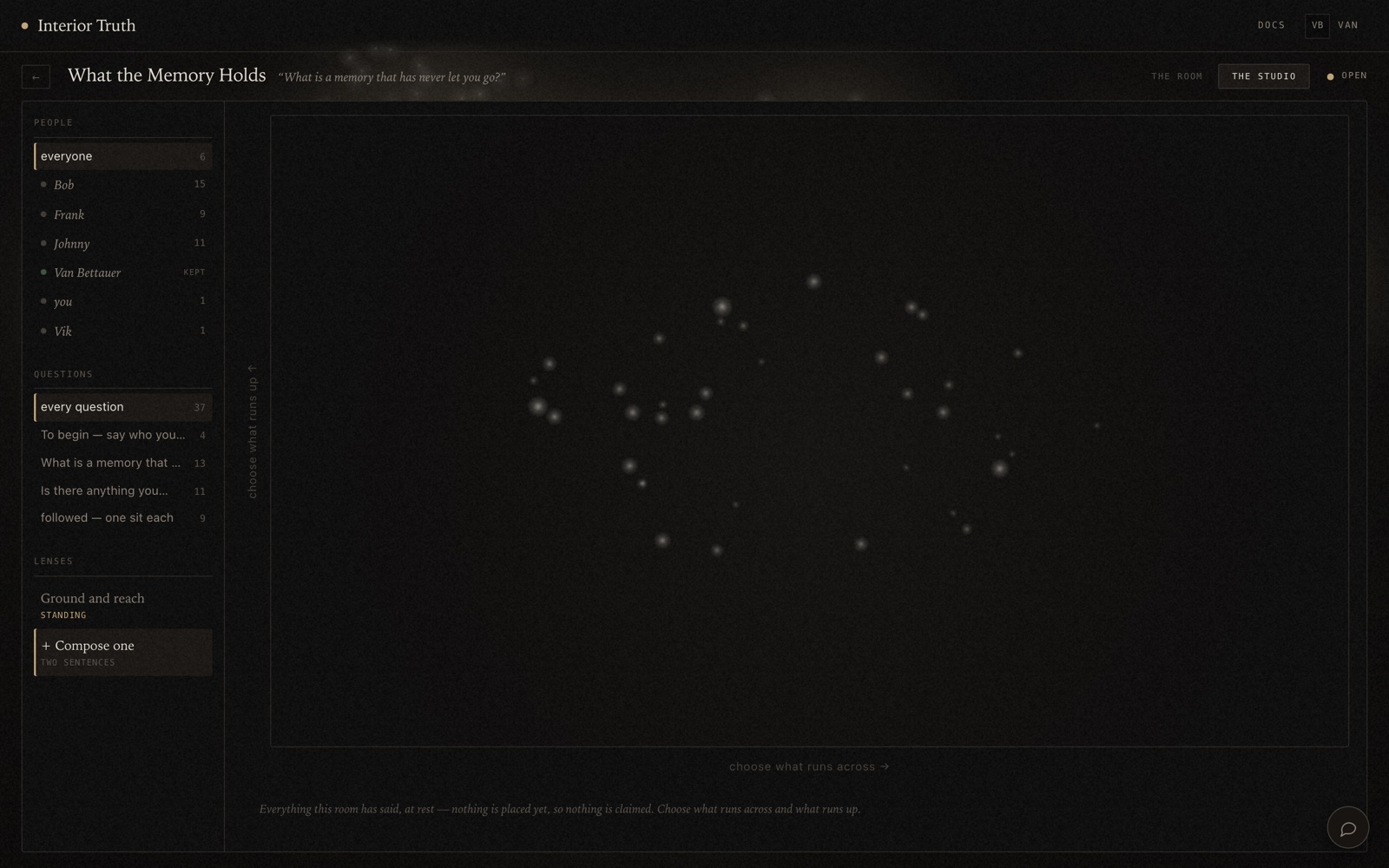
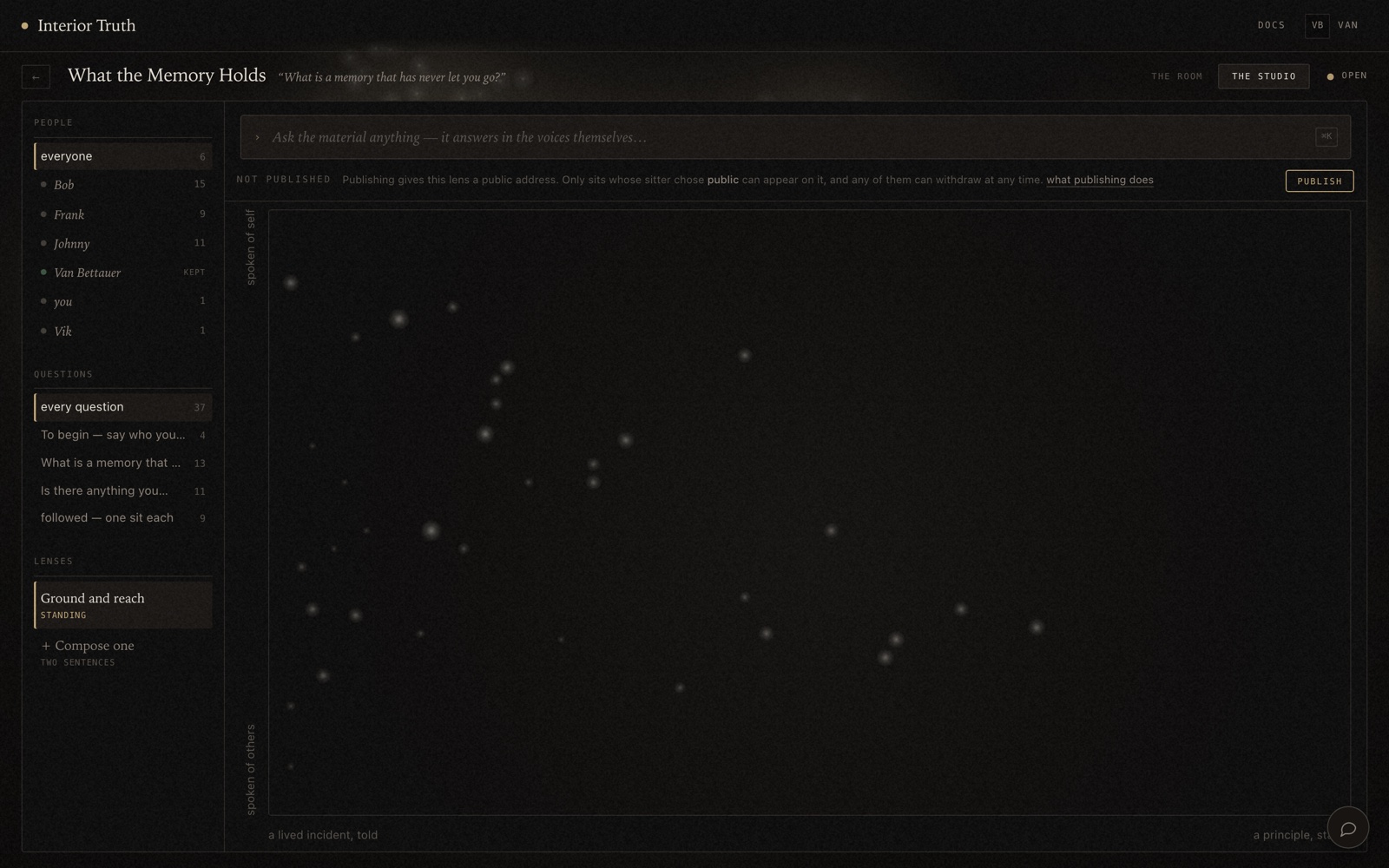
Judging happens per axis, not per lens, so once you have written a few axes the pairings are free: five axes give ten grounds over the same room.
What it costs
Composing is included on every plan, including the free room, with no cap on how many axes you write. Each new axis means reading every moment in the room once.
Rules every lens keeps
- The full range is always shown. If every moment sits at one end, it renders as a band at that end and the surface says so. Nothing is rescaled to fill the frame.
- A silence is not a midpoint. A moment the judgement found neither claim true of goes to a named gutter you can open, never to the middle.
- A position can be checked. Every placement carries the line explaining it, and the moment underneath is playable.
- Scores do not move underneath you. A judgement is written once. Re-judging adds a new pass under its own name rather than overwriting what you already read.
Publish a lens
A room has no public page by default. Publishing one lens is what gives a room an address in the world.

When you publish:
- The lens gets its own link. Anyone with it can see the lens and hear the moments on it.
- Only sits whose owner chose public can appear. Publishing cannot widen anyone's consent.
- The page is a live query. Someone going private or withdrawing removes them on the next load.
- unpublish breaks every copy of the link at once. Publishing again produces a new link rather than reviving the old one.